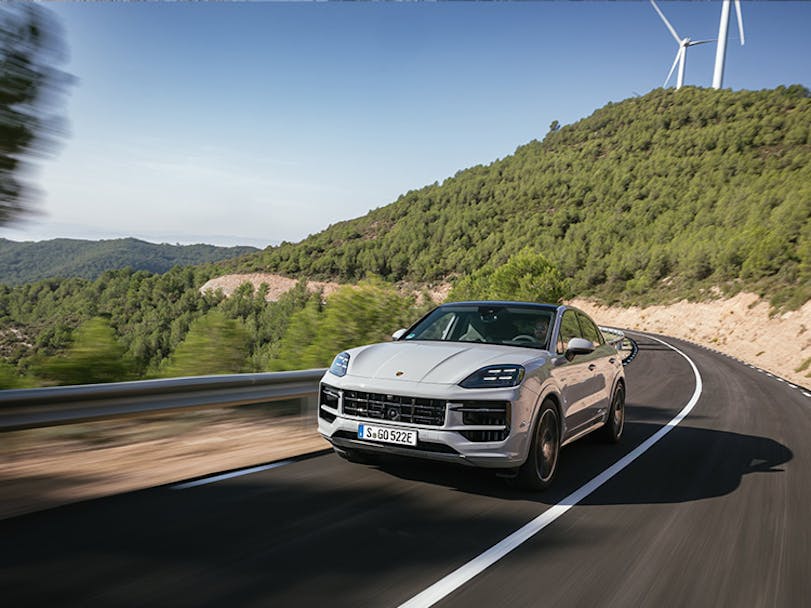
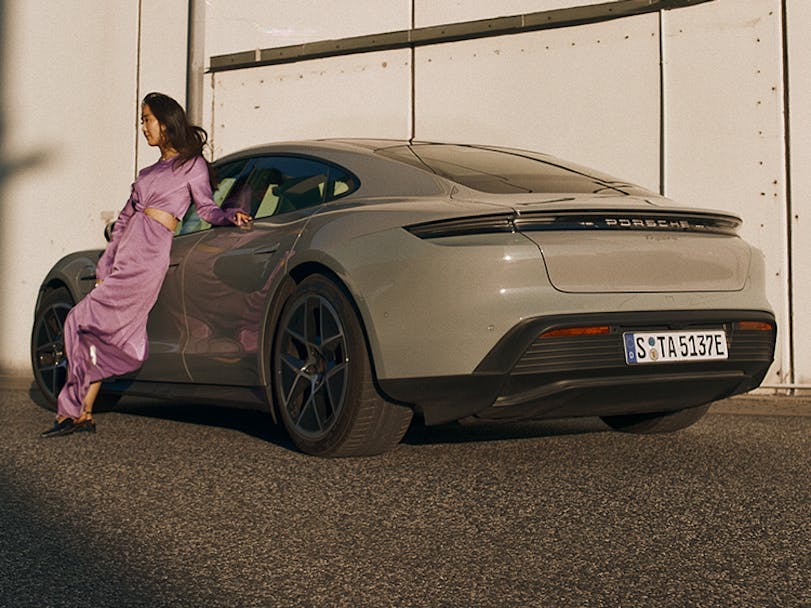
Charging without cables: Porsche engineers explain Wireless Charging
Your essential guide to wirelessly charging the Porsche Cayenne Electric at home
Copy link
Share on Facebook
Share on X
Share on LinkedIn
With the launch of the Cayenne Electric, Porsche has changed charging your car forever. Easy to set up and simple to carry out, wireless charging of your car is now a reality
Porsche Wireless Charging explained• Porsche Wireless Charging is currently available to order for the Porsche Cayenne Electric • Porsche Wireless Charging has up to 11 kW of charging power, similar to wired AC charging• Porsche Wireless Charging is simple to use – just drive your Cayenne Electric over the charging plate – and comes with safety technology to prevent harm to pets or interference from foreign objectsPracticality is taken to the next level for the Cayenne Electric. That’s because, for the first time in a Porsche production model, you can charge it wirelessly – similar to how you can charge your mobile phone – with Porsche Wireless charging.What is Porsche Wireless Charging?Many of us already use wireless technology to charge our smartphones without giving it a second thought. Placing your device on a charging plate and returning later to find the battery fully charged is commonplace. But now, Porsche has scaled up this everyday convenience to charging its newest electric SUV. And it’s just as simple to use as with your phone. The new Porsche Wireless Charging technology comprises just two main components. One is a floor plate that can be installed in your garage, carport or outdoor parking space. The other is a receiver unit built into the underbody of the Cayenne Electric itself, positioned between the front wheels for protection from bad weather and debris.Unlike earlier charging concepts, there is no need to install a separate wallbox or external control unit in your garage. The floor plate is permanently connected to the building’s electrical supply by a qualified electrician. Porsche Wireless Charging is a true one-box solution, making it extremely convenient for owners who want to set up fast. All you have to do is park your Cayenne Electric directly above the plate and activate the parking brake. The charging process then begins automatically. Watch a film about how Porsche Wireless Charging works
?si=TfxsaNd5iPWPPfgi“Many people doubted that it was technically feasible, but we believed in the concept and were determined to make it work,” says Christian Holler, Lead Engineer Wireless Charging at Porsche, on the development of the Wireless Charging system. He reveals the process took nine years from its inception, going through about 20 development iterations before reaching the final concept. This perseverance paid off – Porsche is the first car manufacturer to offer an 11 kW wireless charging system as a series-production, one-box solution. Behind this seemingly simple set-up lies a well-established physical principle called inductive coupling. Inside the floor plate is a transmitter coil made of copper and ferrite. When current flows through it, a magnetic field is created. In the vehicle, a secondary coil receives this magnetic field and generates an alternating current. This is then converted into direct current to charge the high-voltage battery inside the car.“Realising the wireless power transfer itself wasn’t the biggest challenge,” says Simon Schulze, Product Manager at Porsche. “The biggest challenge was to have everything integrated into one box laying on the floor, including all safety and sub-systems.” The Porsche Wireless Charging System is technology designed with ‘future readiness’ in mind. The Porsche Wireless Charging plate – which weighs a robust 50 kg – looks deceptively simple, but is packed with complicated charging technology Photo: PorscheSafety was the top priority when developing the Porsche Wireless Charging systemWhenever new technology enters everyday life, safety questions inevitably follow. “People asked, does it work in the rain? What do I do if I have a flood? What do you do if it snows?” explains Franziska Brunnbauer, Product Manager at Porsche.“The safety mechanisms were really the key concerns of the people,” adds Simon. As a result, Porsche approached wireless charging with safety as its top priority. All live components in the floor plate are sealed and protected from the weather. The system is designed for outdoor use and can withstand vehicles driving over it without sustaining damage. During charging, electromagnetic radiation is limited to the underbody area, and the system operates well below all electromagnetic compatibility limits.Additionally, foreign object detection technology is built directly into the floor plate. “We are super happy to say that it’s a safe system, because we not only have foreign object detection – which detects metal objects – we also detect moving objects,” says Simon. In other words, animals like domestic pets are detected by movement if they crawl under the car when charging. In such instances, the charging process immediately shuts down. The Porsche Wireless Charging System is designed to work outside too – even in cold and snowy conditions Photo: PorscheThis detection technology works by interrupting the charging process if a metallic object, such as a key, lies on the plate and begins to heat up. Live object detection uses motion sensors to identify animals entering the space between the car and the floor plate, causing charging to automatically stop. Ferrites have been installed to guide the magnetic flux in a targeted way and help protect passengers inside the car. The receiver plate in the vehicle is embedded within shielding to prevent the magnetic field spreading upwards into the interior of the vehicle.The Porsche Wireless Charging System has undergone extensive testing, including evaluation by a notified body for electrical safety compliance, and is CE compliant and UL certified.Before the first charging session, the vehicle and floor plate are paired once, similar to connecting a device to your home wifi network. They exchange data and authentication credentials. This prevents misuse and protects against electricity theft. In short, although using the Porsche Wireless Charging may feel effortless, the engineering behind it is meticulous and meets the highest safety standards.As you approach the charging plate, the Cayenne Electric uses UWB (ultra wideband) technology and the PCM Surround View display to guide you visually into the correct position Photo: PorscheThe impressive charging speed and charging power of Porsche Wireless ChargingWireless convenience does not mean compromise. The system delivers up to 11 kW of charging power, which is on a par with wired AC charging. This makes the charging time and performance of the floor plate comparable to those of a traditional wallbox set-up.Due to the ground clearance of the Cayenne Electric, the distance between the floor plate and the receiver unit is between 10-15 cm, yet despite this physical gap, there is energy transfer efficiency of up to 90 per cent from grid to battery. The software continuously monitors positioning and adjusts charging parameters. Since over 75 per cent of all charging processes for all-electric Porsche models take place at home, the potential for this kind of convenience is huge.The wireless transfer of energy between the charging plate and vehicle takes place over a distance of a few centimetres Photo: PorscheThe gamification of parking with Porsche Wireless ChargingAs you drive up to the charging plate, UWB (ultra-wideband) determines the car’s position relative to the charging plate, helping the driver position the vehicle correctly. On the PCM display inside the car, you can see a green dot representing the receiver in the car within the Surround View parking function. A green circle marks the charging coil in the floor plate. All you have to do is guide the dot into the circle to get into the perfect position. It’s a bit like playing a game you’ll always win.“You just sit behind the wheel, you have the guiding lines, you just drive. And it really is that easy,” explains Franziska. Even if your parking job is not perfect, the system tolerates up to 10 cm of misalignment, with the software compensating for this in real time.Once the parking brake is activated as part of the normal parking process, charging starts automatically – no additional button press or confirmation is required. Timer charging and preconditioning functions, as seen with AC charging, are also available. You can monitor everything through the My Porsche app, authenticate multiple vehicles, and track charging sessions remotely. With Porsche Wireless Charging, convenience is at its heart.
Consumption and emission informationCayenne Electric
(WLTP): Electric energy consumption combined: 22.0 – 19.7 kWh/100 km; CO₂ emissions combined: 0 g/km.
Cayenne Turbo Electric
(WLTP): Electric energy consumption combined: 22.5 – 20.4 kWh/100 km; CO₂ emissions combined: 0 g/km.
Build your new Cayenne Electric
Configure yours
Continue reading
How much is a Porsche Cayenne?
Discover more about the sporty SUV model, from how much it costs and which versions are sold where you live
Read more
How much is a Porsche Taycan?
What every Taycan costs, where each body style is sold, and how far and fast each model goes
Read more
Cayenne Electric performance: how Porsche engineers make the power usable
The powerful performance of the Cayenne Electric is the result of extensive development on and off the test track. Meet the Porsche engineers and test drivers who explain how they achieved it
Read more