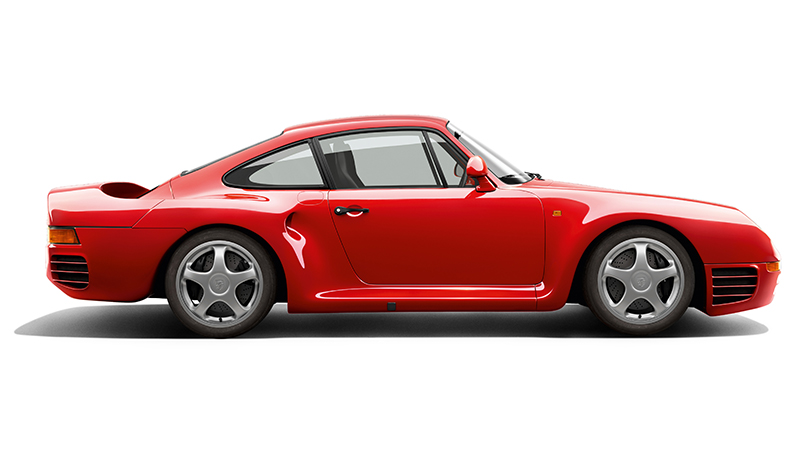
The group B regulation was introduced into motor racing in 1980. Created for competition cars of which at least 200 had been produced, it provided the opportunity to develop the 959 – the new super Porsche. Since this production figure was unlikely to be achieved through sales to active racing drivers, the construction of a special car was out of the question. The aim was rather to build on an existing series. The choice fell to the 911.
The first development results took the form of a group B survey in 1983 at the IAA in Frankfurt. The positive echo from the public signalled the go-ahead. The decision to build an all-wheel drive was taken early in the proceedings as offering the best chances for rally success. The decision proved correct. In 1984 a four-wheel drive 911 won the Paris-Dakar rally. The 959 prototypes entered the following year took no prizes but in 1986 the 959s earned a double victory.
In 1985 Porsche had presented the street-legal 959 at the IAA in Frankfurt and orders soon outstripped production capacity. Customers nevertheless had to exercise patience. The 959, which also represented cutting-edge technology, was developed to the highest level of maturity by the designers and engineers. It was therefore 1987 before the first customer took receipt of the longingly awaited car.
It was worth the wait, however, the 959 was a sensation. From a technical perspective it was a racing car ”nevertheless the result is a car which has all the comfort and smoothness and no more interior noise that we expect from a road vehicle along with a high safety margin”, said the head of development of the time, Helmuth Bott, not without pride.
| Technical Specifications | |
|---|---|
| Engine: | six cylinder Boxer, water-cooled cylinder heads, two upper camshafts on each side, four valves per cylinder, two turbochargers with intercoolers |
| Power: | 450 HP (330 kW) at 6500/min |
| Displacement: | 2884 ccm |
| Fuel system: | Bosch Motronic with pressure gauge, tank capacity 85 litres |
| Transmission: | six speed gearbox |
| Chassis: | self supporting plastic and alloy bodywork, independent suspension front and rear on double transverse links, coil springs, variable telescopic shock absorbers and stabilisers |
| Dimensions and weight: | wheel base: 2,272 mm length: 4,260 mm width: 1,840 mm height: 1,280 mm weight: 1,450 kg |
| Performance: | 315 km/h |